WhatsApp
LinkedIn
X
Facebook
Telegram
Threads
BIM (Building Information Modelling), is a revolutionary, holistic information process in the architecture, engineering and construction (AEC) sector that manages the entire life cycle of buildings—from design to demolition—in a digital environment. Unlike traditional two-dimensional (2D) drawings, BIM creates intelligent 3D models, bringing together not only geometric data but also ‘invisible’ data (metadata) such as cost, time, material properties and energy performance in a single centralised system. This article details the origins, global significance, sectoral importance, and future of BIM technology, which forms the digital backbone of the construction industry.
The History of BIM
BIM was not suddenly invented by a single company; it has evolved through academic visions and investments by software companies:
- Originator: The concept of BIM was first proposed in the 1970s by Professor Charles Eastman of Carnegie Mellon University. In his 1975 article, Eastman presented his vision of "using computers instead of drawings" and laid the foundation for modern BIM with the "Building Definition System" (BDS) he developed.
- The First Commercial Software: The technology that entered our lives commercially in the 1980s was introduced to architects in 1987 under the "Virtual Building" concept with Graphisoft’s ArchiCAD software.
- The Rise to Popularity: In the early 2000s, the term “BIM” became a global standard following Autodesk’s acquisition and further development of the Revit software. Today, technology giants such as Autodesk, Bentley Systems, Trimble, and Nemetschek continue to develop and manage BIM software.
What Is BIM Used For, and How Does It Work?
BIM ensures that information is accurate and accessible at every stage of the project. Their functions are defined by their dimensions (D):
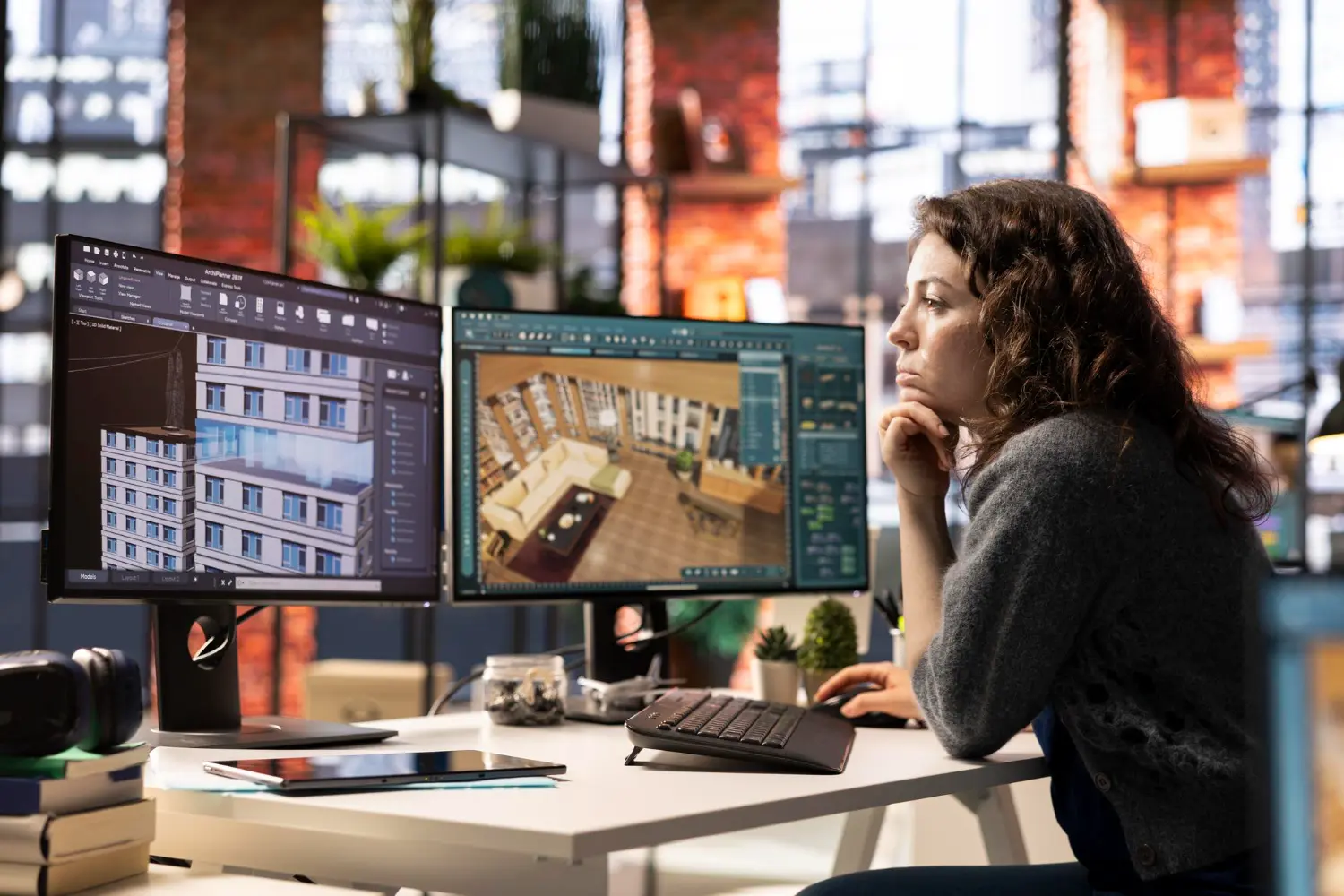
- 3D (Visualization and Coordination): All architectural, structural, and mechanical components of the building are modeled in three dimensions.
- 4D (Time Scheduling): By adding a time parameter to the digital model, the day-by-day progress of the construction is simulated.
- 5D (Cost Analysis): Material prices are integrated into the model; as the design changes, the budget is automatically updated.
- 6D & 7D (Sustainability and Facility Management): The building’s energy consumption is analyzed, and once the building is completed, the entire operations process—from light bulb replacement to HVAC maintenance—is monitored using this model.
BIM Users
BIM is a collaborative workspace that brings together all stakeholders in a construction project on a single cloud platform:
- Architects and Designers: To create aesthetic designs and conceptualize spaces.
- Civil, Mechanical (MEP), and Electrical Engineers: To analyze structural systems and position piping and cabling so they do not interfere with one another.
- Contractors and Site Managers: To determine the correct amount of material and ensure error-free installation on-site.
- Building Owners and Facility Managers: To manage the building’s maintenance and repair activities using digital data after construction is complete.
The Importance of Technology
The critical benefits of BIM, which boosts productivity in the construction industry, are as follows:
- Clash Detection: It would be a major problem if, after concrete has been poured at a construction site, it were discovered that a ventilation duct had collided with a beam. BIM identifies these physical conflicts on a computer screen (without having to go to the construction site).
- Cost and Time Savings: Since it minimizes the margin of error, it prevents defective products from having to be demolished and rebuilt; projects are completed on time.
- Real-Time Collaboration: Architects and engineers in different countries around the world can work on the same model in real time over the internet.
Global Significance
BIM is no longer a luxury engineering choice—it is a global necessity.
- Legal Requirements: The United Kingdom is one of the pioneering countries that requires modeling at a specific level (BIM Level 2) for publicly funded projects. Similarly, in countries such as the United States, Singapore, Norway, Germany, and China, the use of BIM in large-scale public projects is a legal requirement.
- Global Market: All major cities pursuing smart city initiatives—particularly in the Asia-Pacific region and North America—are implementing their infrastructure projects using BIM technology.
Future Developments and Trends
BIM technology is not a static system; it continues to evolve by integrating with Industry 4.0 components:
- Digital Twins: This refers to a structure that is synchronized with real-time IoT (Internet of Things) sensor data. Digital Twins: This refers to a structure that is synchronized with real-time IoT (Internet of Things) sensor data.
- Artificial Intelligence (AI) Integration: AI-powered BIM systems can automatically generate the most cost-effective and durable architectural and structural solutions within seconds by scanning thousands of design variations.
- Artificial Intelligence (AI) Integration: AI-powered BIM systems can automatically generate the most cost-effective and durable architectural and structural solutions within seconds by scanning thousands of design variations.
BIM technology has ushered in a new era—one that is data-driven, transparent, and sustainable—by breaking down the construction industry’s traditional and fragmented way of working, which dates back thousands of years. In the future, with artificial intelligence and digital twins taking full control, no player unfamiliar with BIM will be able to compete in the global construction market.